

Understanding Interest Rates: How They Work and How Borrowers Decide
Interest rates are the cost of borrowing money. When someone takes out a mortgage, the interest rate determines how much they pay the lender over time in exchange for using a large amount of money to buy a home. While interest rates are often discussed in abstract or emotional terms, they follow clear rules and predictable mechanics.
How a Mortgage Works
In Canada, most mortgages are structured with a 25-year amortization. This means the loan is designed to be fully paid off over 25 years through regular monthly payments. Each payment includes two parts: interest, which is the cost of borrowing, and principal, which reduces the amount owed. When interest rates are higher, more of each payment goes toward interest. When rates are lower, more of the payment goes toward paying down the loan.
Mortgage rates are quoted annually, but payments are calculated monthly. Lenders use a standard formula to determine a payment amount that will repay both interest and principal over the full amortization period. Even small changes in interest rates can meaningfully affect monthly payments, particularly on larger mortgage balances.
Fixed Rates
Fixed mortgage rates in Canada are closely tied to the Government of Canada five-year bond yield. Government bonds are considered very low risk, so their yields are used as a reference point for pricing longer-term loans like five-year fixed mortgages. As of early January 2026, the five-year Government of Canada bond yield is around 2.9 percent. Lenders do not lend at this rate directly. They add a margin on top to cover operating costs, risk, and profit. Once that margin is applied, fixed mortgage rates offered to consumers today tend to fall in the high-3 percent range, depending on the lender and borrower profile.
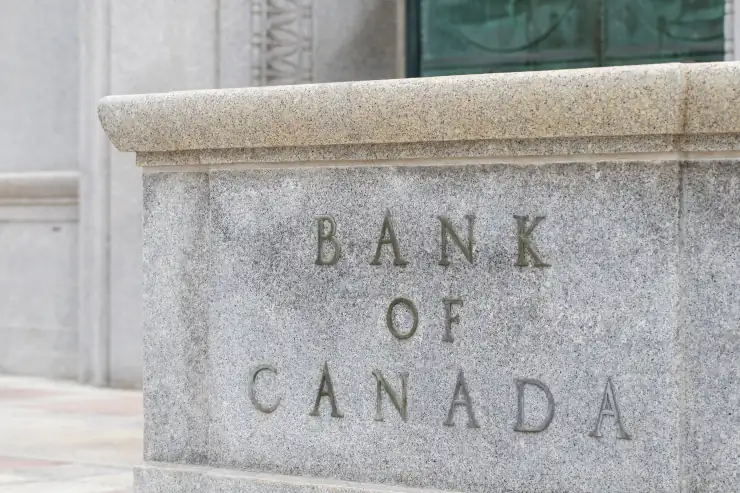
While bond yields form the base for fixed rates, central bank policy shapes the broader interest rate environment. In Canada, the Bank of Canadasets the overnight policy rate, which influences short-term borrowing costs throughout the economy. This policy rate directly affects variable interest rates and indirectly affects fixed rates by shaping market expectations around inflation and economic growth.
Variable Rates
Variable interest rates operate differently from fixed rates. Instead of being locked in, variable rates move over time based on changes to a lender’s prime rate. Prime is the benchmark rate banks use for many lending products, including variable-rate mortgages, lines of credit, and some auto and personal loans. When the central bank raises or lowers its policy rate, banks usually adjust their prime rate by the same amount, and variable-rate loans change accordingly.
Because of this structure, variable rates respond quickly to economic conditions. They tend to rise or fall shortly after central bank decisions. This makes them common for shorter-term or flexible borrowing, such as home equity lines of credit, open mortgages, personal lines of credit, and auto loans. These products are designed to adjust with the economy rather than remain fixed for long periods.
The specific variable rate a borrower receives is expressed as a discount or premium to prime. For example, a borrower may be offered prime minus 0.50 percent or prime plus 1.00 percent. This adjustment is determined by several factors, including the borrower’s credit strength, income stability, loan size, and whether the loan is secured or unsecured. Market competition also plays a role. When lenders are competing aggressively, discounts to prime tend to increase. When risk or funding costs rise, discounts shrink or premiums grow.

Weighing the Options
Choosing between a fixed and variable mortgage rate is one of the most important decisions a borrower makes, and there is no single correct answer. A fixed-rate mortgage offers certainty. The rate and payment stay the same for the length of the term, making budgeting simple and predictable. This can be valuable for borrowers who prefer stability or who have limited room in their budget for payment increases.
Variable-rate mortgages offer flexibility. They usually start with lower rates than fixed mortgages and often come with lower penalties if the borrower needs to break the mortgage early. However, they expose the borrower to the risk that rates and borrowing costs could increase over time. Depending on the structure, this can mean higher payments or slower repayment of the loan.
The key differences between fixed and variable rates are not about which option is “better,” but about how each handles risk. Fixed rates trade flexibility for certainty. Variable rates trade certainty for flexibility. The right choice depends on a borrower’s risk tolerance, income stability, future plans, and ability to manage changes in payments or interest costs.
Importantly, choosing between fixed and variable rates is not about predicting where interest rates will go next. Even experts struggle to forecast rate movements accurately. A better approach is to focus on personal circumstances: how stable income is, how long the borrower plans to keep the mortgage, how sensitive the household budget is to change, and how much uncertainty the borrower is willing to accept.
Conclusion
In the end, interest rates are not mysterious forces working against borrowers. They are tools used to price risk, manage inflation, and allocate capital across the economy. Mortgages simply translate those rates into long-term payment plans. When borrowers understand how rates are set, how they move, and how different mortgage types respond to them, decision-making becomes less emotional and more practical.
The goal is not to outguess the market, but to choose a mortgage structure that fits the borrower’s financial life. When that alignment exists, interest rate changes become manageable events rather than sources of stress, and the mortgage becomes a tool rather than a gamble.